Evolution from Industry 1.0 to Industry 4.0

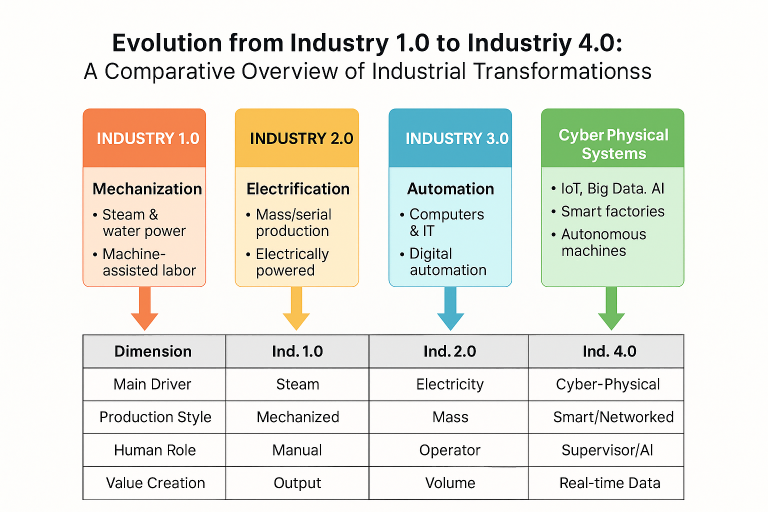
Evolution from Industry 1.0 to Industry 4.0: A Comparative Overview of Industrial Transformations

Industry 1.0 – Mechanization (Late 18th Century)

Driven by steam power, water power, and natural resources (coal, iron, waterways).

Marked the shift from agrarian to industrial societies.

Improved heavy industries such as textiles and iron.

Labour remained central but supported by machines.

Industry 2.0 – Electrification (Early 20th Century)

Electricity replaced steam as the main energy source.

Enabled mass/serial production and assembly-line systems.

Boosted productivity and helped form the economic middle class.

Industry 3.0 – Automation (1970s Onward)

Emergence of computers, transistors, programming, and robotics.


Introduced IT-based automation, digital design, and numerical control machines.

Marked the rise of the information society.

Industry 4.0 – Networking / Cyber-Physical Systems (21st Century)

Created as Germany’s strategic response to global competition.

Focuses on networked systems, IoT, Big Data, smart factories.

Integrates real and digital worlds through cyber-physical systems.


Machines communicate autonomously across the value chain.


Removes the human intermediary between physical and digital operations.

Related Posts

Dark navy blue banner featuring the bold white text 'BIM Meetings' at the center, surrounded by lighter gray BIM-related terms such as 'BIM Kick-off', 'Clash Detection', 'Progress Review', and 'Project Handover' in a structured, professional layout."
BIM

Meetings in BIM

In BIM (Building Information Modeling), meetings play a crucial role in ensuring collaboration, coordination, and alignment among all project stakeholders. Here are the common types of meetings in BIM workflows:

Read More »

Meetings in BM

In BIM (Building Information Modeling), meetings play a crucial role in ensuring collaboration, coordination, and alignment among all project stakeholders. Here are the common types of meetings in BIM workflows:

Read More »
BIM

The BIM Manager VS BIM Coordinator​

The role of a BIM Manager is critical in ensuring the smooth integration of Building Information Modeling processes throughout a project. They develop and implement the overall BIM strategy, establish

Read More »